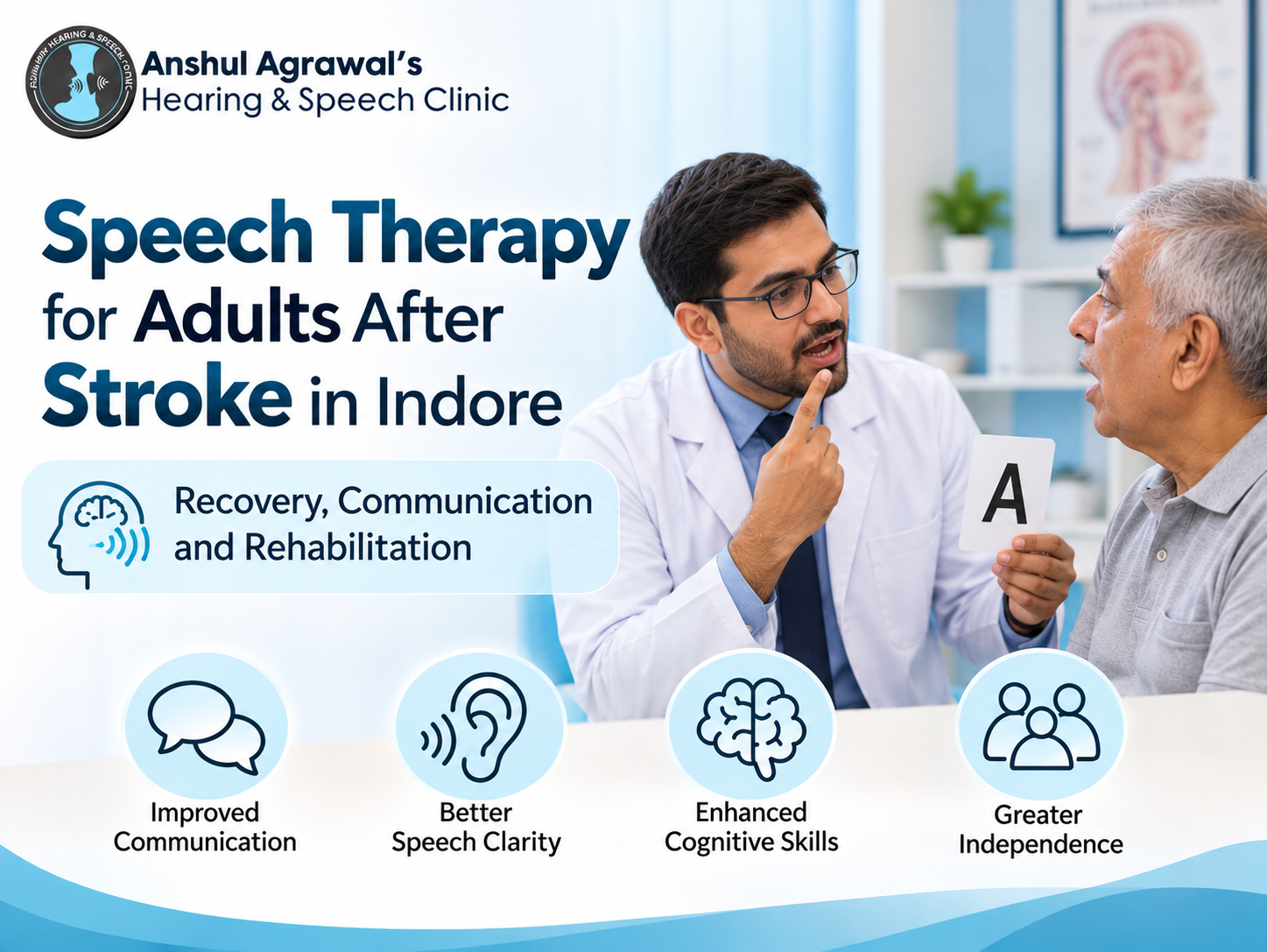
Speech Therapy for Adults After Stroke in Indore plays an important role in helping stroke survivors improve communication, speech clarity, language understanding and, when needed, swallowing function. A stroke can affect the parts of the brain responsible for speaking, understanding language, reading, writing and coordinating the muscles involved in speech. With appropriate assessment and an individualised rehabilitation plan, many people can work toward improving their communication skills and participating more confidently in daily life. At Anshul Agrawal Hearing and Speech Clinic, Anshul Agrawal focuses on hearing, speech and communication care for children and adults. The clinic, located in South Tukoganj near Nath Mandir Road, provides services related to speech difficulties, communication disorders and hearing rehabilitation.
After a stroke, communication challenges can affect conversations with family members, social interactions, independence and emotional well-being. Some people know what they want to say but struggle to find the correct words, while others may have difficulty understanding spoken language or producing clear speech. The type of difficulty varies from person to person, which is why professional assessment is important. This guide explains the common speech and language problems that can occur after a stroke, how speech therapy works, what recovery may involve and how families can support rehabilitation.
What Happens to Speech and Communication After a Stroke?
A stroke occurs when the blood supply to part of the brain is interrupted or when bleeding damages brain tissue. Since different areas of the brain control different functions, the communication problems that follow depend on the location and extent of the injury. Some stroke survivors experience difficulty forming words, while others struggle to understand sentences, read written information or express their thoughts. A person may also have problems controlling the muscles required for clear speech. Speech Therapy for Adults After Stroke in Indore begins with understanding the specific communication challenges a person is experiencing. An assessment can help identify the skills that need attention and establish practical rehabilitation goals.
Common changes after a stroke include:
- Difficulty finding the right words.
- Slurred or unclear speech.
- Trouble understanding conversations.
- Difficulty reading or writing.
- Problems forming complete sentences.
- Reduced ability to participate in group conversations.
- Changes in voice quality or speech rhythm.
- Difficulty communicating needs, emotions or preferences.
Not every stroke survivor develops these difficulties. Some people experience mild changes, while others need a longer period of rehabilitation and ongoing support.
Common Speech and Language Disorders After Stroke
1. Aphasia
Aphasia is a language disorder that can develop when a stroke damages brain regions involved in language processing. It can affect speaking, understanding, reading and writing. A person with aphasia may understand an idea but struggle to find the words needed to express it. Another person may speak fluently but have difficulty understanding what others are saying. Aphasia does not necessarily mean that a person’s intelligence has been affected. The person may continue to understand situations and emotions even when communicating those thoughts becomes difficult.
2. Dysarthria
Dysarthria is a motor speech disorder caused by weakness or reduced coordination of the muscles used for speaking. Speech may sound slurred, slow, quiet or difficult to understand. Therapy may focus on improving breath support, speech clarity, articulation, speaking rate and coordination, depending on the individual’s abilities.
3. Apraxia of Speech
Apraxia of speech affects the brain’s ability to plan and sequence the movements needed for speech. A person may know what they want to say but struggle to produce the sounds in the correct order. Treatment may involve repeated, structured speech practice and techniques that help the person plan and produce speech movements more accurately.
4. Cognitive-Communication Difficulties
Some stroke survivors experience difficulties with attention, memory, organisation or interpreting information. These changes can make conversations and everyday communication more challenging. Therapy may include strategies for following conversations, organising thoughts, remembering important information and communicating effectively in real-life situations.
Who Needs Speech Therapy After a Stroke?
Speech and language rehabilitation may be appropriate for adults who experience new communication difficulties following a stroke. The need for therapy depends on the person’s symptoms, medical condition, assessment results and rehabilitation goals.
A speech-language professional may recommend an evaluation if a person:
- Has difficulty speaking clearly.
- Struggles to find or remember words.
- Cannot easily understand spoken instructions.
- Has difficulty reading messages or writing sentences.
- Finds telephone conversations challenging.
- Avoids social situations because of communication difficulties.
- Has trouble communicating basic needs.
- Experiences changes in speech coordination.
Stroke Speech Therapy in Vijay Nagar, Indore may be a relevant local search for families looking for rehabilitation support after a stroke. However, the most suitable service should be selected based on the patient’s clinical needs, the therapist’s qualifications and the availability of appropriate assessment and treatment. If speech or language difficulties begin suddenly, particularly with facial weakness, arm weakness, confusion or loss of balance, seek emergency medical care immediately. Do not wait for a routine therapy appointment.
How Speech Therapy Helps Adults Recover After a Stroke
Speech therapy is designed around the person’s communication abilities, challenges and everyday needs. It does not follow the same routine for every stroke survivor. A therapist first evaluates the person’s speech, language, understanding and other relevant communication skills before recommending treatment activities. Speech Therapy for Adults After Stroke in Indore may involve several approaches, depending on the type of impairment.
Improving Word Finding and Sentence Formation
Some people know what they want to communicate but cannot easily retrieve the words they need. Therapy may use pictures, naming exercises, word associations, sentence completion and conversation practice to strengthen communication skills. For example, a person might practise naming familiar objects, describing a daily activity or forming sentences about a photograph. Activities can gradually become more challenging as the person’s abilities and goals develop.
Improving Speech Clarity
When muscle weakness or coordination affects speech, therapy may focus on clear sound production, speaking at a manageable pace and coordinating breathing with speech. A therapist may practise useful words and short sentences before introducing longer conversations. The aim is to help the individual communicate more effectively in everyday situations.
Improving Language Understanding
Some stroke survivors have difficulty following conversations, understanding instructions or processing longer sentences. Treatment may include listening exercises, following directions, identifying key information and practising communication in familiar situations.
Building Functional Communication
Communication rehabilitation should extend beyond structured exercises. The ability to ask for assistance, discuss personal preferences, speak with family members and take part in everyday decisions can be important goals.
A Speech Therapist for Stroke Patients in South Tukoganj, Indore may assess these functional needs and develop activities suited to the individual’s daily routine.
Supporting Alternative Communication Methods
When speaking is difficult, other methods may help a person express their needs. These can include gestures, writing, communication boards, pictures or suitable digital communication tools. Using alternative methods does not mean giving up on speech improvement. They can help maintain communication and independence while the person continues working toward appropriate rehabilitation goals.
Understanding Aphasia Treatment After Stroke
Aphasia can affect people in different ways. Some individuals have difficulty expressing themselves, while others struggle to understand language or use reading and writing skills. Treatment should reflect the particular pattern of difficulty.
Adult Speech Therapy in Palasia, Indore may be a search phrase used by families seeking adult communication rehabilitation. During an assessment, a qualified speech-language professional can identify whether the main challenge involves language processing, speech production or a combination of difficulties.
Aphasia therapy may include:
- Naming everyday objects and people.
- Practising meaningful words and phrases.
- Understanding spoken questions.
- Following instructions of increasing complexity.
- Reading words, sentences or short passages.
- Writing useful information.
- Practising conversations relevant to daily life.
- Learning communication strategies with family members.
The therapist may also recommend exercises for home practice. These activities should match the person’s abilities and avoid causing unnecessary frustration or fatigue.
Can Aphasia Improve After a Stroke?
Improvement is possible, but recovery varies. Some people make noticeable progress in the early stages, while others continue to benefit from rehabilitation over a longer period. The severity of the stroke, the type of language difficulty, other health conditions, access to therapy and individual responses can influence outcomes. There is no universal timeline or guarantee of complete recovery. Regular reassessment helps determine whether treatment goals and activities need to change.
Speech Rehabilitation After Stroke: What Does Treatment Involve?
Speech Rehabilitation After Stroke in Bhawarkua, Indore reflects a common local search for post-stroke communication care. Rehabilitation generally begins with an evaluation and continues through structured practice, feedback and periodic review.
Initial Assessment
The therapist may ask about the stroke history, communication changes, medical care and the situations in which the person experiences difficulty. Assessment may examine speech clarity, language comprehension, naming, reading, writing and functional communication. If swallowing difficulties are suspected, they require specific assessment and appropriate referral or management. Not every speech therapist or clinic provides every type of swallowing service, so families should confirm this when making an appointment.
Individualised Therapy Goals
Goals should be practical, measurable and meaningful to the patient. One person may want to communicate basic needs more clearly, while another may aim to participate in family conversations or return to selected work activities.
Examples of goals include:
- Saying familiar words more clearly.
- Communicating a choice or request.
- Understanding short instructions.
- Using a phone or communication aid.
- Taking turns during a conversation.
- Reading everyday messages.
- Writing important words or personal details.
Guided Practice and Feedback
Therapy often involves practising specific skills with feedback from the therapist. Activities may be repeated and adjusted according to progress. The aim is to build skills that can transfer from the therapy setting to everyday communication.
Progress Reviews
Progress can be gradual and may vary from week to week. Periodic reviews help identify which strategies are working and whether goals need to be adjusted. The family and patient should be involved in these discussions so that therapy remains relevant to daily life.
Speech Therapy for Stroke Patients in Daily Life
Rehabilitation becomes more useful when communication strategies are practised outside formal sessions. Everyday activities provide opportunities to use words, understand information and participate in conversations without turning every interaction into a test. Speech Therapy for Stroke Patients in Nipania, Indore may be relevant to families exploring local options for communication rehabilitation. The treatment plan should consider the patient’s stamina, interests, home environment and specific communication goals.
Practical activities may include:
- Talking about familiar family members or daily routines.
- Naming objects while preparing a meal or organising personal items.
- Reading short messages together.
- Practising common questions and responses.
- Looking at photographs and describing what is happening.
- Using written keywords or pictures to support conversations.
- Practising communication during calm, familiar activities.
The therapist can guide families on which activities are suitable and how to provide support without taking over the conversation.
How Family Members Can Help
Family involvement can support communication practice, particularly when the person feels comfortable and understood.
Helpful approaches include:
- Speak clearly at a natural pace.
- Reduce background noise where possible.
- Allow extra time for the person to respond.
- Ask one question at a time when necessary.
- Use gestures, written words or pictures if helpful.
- Confirm meaning respectfully instead of pretending to understand.
- Encourage participation without pressuring the person to speak perfectly.
Avoid correcting every mistake or finishing every sentence automatically. Give the person time to express their thoughts and ask whether they would like help.
What Is the Role of a Speech Therapist After a Stroke?
A speech-language therapist evaluates communication difficulties, identifies appropriate treatment goals and guides rehabilitation exercises. The therapist may also advise the family on communication strategies and recommend other professional assessments when required. Aphasia Treatment and Speech Therapy in Rau, Indore may be searched by families whose loved ones have difficulty understanding language, finding words or forming sentences after a stroke. A detailed assessment is important because aphasia and motor speech disorders require different treatment approaches.
Depending on the person’s needs, the therapist may work on:
- Spoken language and vocabulary.
- Understanding questions and instructions.
- Speech sound production.
- Conversation skills.
- Reading and writing.
- Communication aids and compensatory strategies.
- Family education and home practice.
A therapist may also coordinate with doctors, physiotherapists, occupational therapists, psychologists and other rehabilitation professionals as part of a wider recovery plan.
How Long Does Speech Therapy Take After a Stroke?
There is no fixed duration for speech therapy after a stroke. Some people need a short course focused on specific goals, while others benefit from continued therapy and periodic reassessment over months or longer.
The duration depends on factors such as:
- The severity and location of the stroke.
- The type of speech or language impairment.
- The person’s overall health and energy levels.
- The ability to practise between sessions.
- The individual’s response to treatment.
- The communication goals agreed upon with the therapist.
Speech and Communication Therapy After Stroke in Bengali Square, Indore may be a useful local search for people seeking ongoing rehabilitation support. When comparing services, ask about assessment procedures, treatment goals, session planning and how progress is reviewed. More therapy is not automatically better in every situation. The frequency and length of sessions should be tailored to the person’s tolerance, needs and clinical recommendations.
When Should Speech Therapy Begin?
Medical assessment and treatment of an acute stroke take priority. Once the patient is medically stable, the rehabilitation team can assess communication and determine when therapy should begin. Early assessment can help identify difficulties and establish appropriate goals. However, the timing and intensity of therapy depend on the person’s medical condition, alertness, stamina and ability to participate. People can still benefit from communication support later in recovery. It is not necessarily too late to seek an assessment simply because the stroke occurred months or years earlier. Speech Therapist for Adults After Stroke in Saket Nagar, Indore may be a relevant search for families looking for adult rehabilitation services. Before starting, confirm that the professional has appropriate training and experience in adult neurogenic communication disorders.
What to Look for When Choosing a Speech Therapy Clinic
Choosing a clinic involves more than considering distance. Patients and caregivers should understand the therapist’s qualifications, experience with post-stroke communication disorders and approach to individualised care.
Consider asking the following questions:
- Does the therapist assess aphasia, dysarthria and other post-stroke communication difficulties?
- Will the treatment plan be tailored to the patient’s needs?
- How will progress be measured?
- Are caregivers included in communication training when appropriate?
- What home-practice activities may be recommended?
- Can the therapist coordinate with the patient’s wider rehabilitation team?
- Are swallowing concerns assessed or referred to an appropriate professional when needed?
A clear explanation of the assessment and treatment plan can help families make informed decisions.
How Anshul Agrawal Hearing and Speech Clinic Supports Communication Care
Anshul Agrawal Hearing and Speech Clinic provides hearing and speech-related services for children and adults in Indore. According to the supplied clinic profile, Anshul Agrawal combines clinical assessment with patient-focused therapy and communication guidance. For adults recovering from a stroke, the first step is to determine whether the main concern involves language, speech clarity, communication planning or a combination of difficulties. The appropriate treatment should then be based on the assessment rather than a standard exercise programme. Speech Therapy for Adults After Stroke in Indore should focus on meaningful communication goals, realistic expectations and regular review of progress. Where appropriate, family members can learn strategies to help the person communicate more comfortably at home. The clinic’s location in South Tukoganj, near Nath Mandir Road, may be convenient for some Indore residents. Patients should contact the clinic to confirm current services and whether a specific adult post-stroke rehabilitation programme is available.
Local Considerations for Post-Stroke Speech Rehabilitation in Indore
Families often look for rehabilitation close to home because regular appointments and home practice may be part of the recovery plan. Local searches can help identify possible services, but patients should verify the clinic’s location and expertise before choosing a provider. For people exploring Stroke Speech Therapy in Vijay Nagar, Indore, the important consideration is whether the therapist can assess the person’s particular speech and language needs.
Those searching for a Speech Therapist for Stroke Patients in South Tukoganj, Indore should ask about experience with adult neurological rehabilitation and the process used to set individual goals. People looking for Adult Speech Therapy in Palasia, Indore may wish to confirm whether the service includes assessment of language, speech clarity, reading and writing where relevant. For Speech Rehabilitation After Stroke in Bhawarkua, Indore, families can ask how therapy goals are reviewed and whether practical home exercises are included.
Patients searching for Speech Therapy for Stroke Patients in Nipania, Indore should explain the difficulties they have noticed, such as word-finding problems, unclear speech or difficulty following conversations. For individuals needing Aphasia Treatment and Speech Therapy in Rau, Indore, assessment can help distinguish language difficulties from problems involving speech muscle coordination.
People researching Speech and Communication Therapy After Stroke in Bengali Square, Indore can ask whether communication aids and family guidance are included when appropriate. Those considering a Speech Therapist for Adults After Stroke in Saket Nagar, Indore should confirm the professional’s experience in adult speech-language rehabilitation and the availability of a suitable assessment. These locality-based terms help describe what people may search for online; they do not confirm that a particular service is available in every named neighbourhood.
Frequently Asked Questions
1. Can an adult recover speech completely after a stroke?
Some adults regain many of their previous communication abilities, while others continue to experience difficulties. Recovery depends on several factors, including the stroke, the type of impairment and the person’s response to rehabilitation. Complete recovery cannot be guaranteed.
2. Is speech therapy useful if a person understands everything but cannot speak clearly?
Yes. If the primary difficulty involves speech production, muscle coordination or planning speech movements, a therapist can assess the cause and recommend appropriate exercises and communication strategies.
3. Can a person with aphasia still understand emotions and social situations?
Yes. Aphasia primarily affects language, although its impact varies. A person may understand emotions, intentions and situations even when finding words or understanding sentences is difficult.
4. Should family members correct every speech mistake?
Not necessarily. Constant correction may make conversations stressful. It is usually more helpful to allow time, listen patiently and provide cues or corrections when they support the person’s agreed therapy goals.
5. Can speech therapy help with reading and writing after a stroke?
Yes. When stroke-related language difficulties affect literacy, therapy may include reading comprehension, recognising words, writing useful information and practising everyday written communication.
6. Is home practice necessary between sessions?
Home practice can reinforce skills introduced during therapy. Activities should be recommended by the therapist and adjusted to the person’s abilities, energy levels and treatment goals.
7. Can someone begin speech therapy several months after a stroke?
Yes. An assessment may still be useful months or years after a stroke. The therapist can evaluate current abilities and identify realistic goals for communication improvement.
8. Does speech therapy also treat swallowing difficulties?
Some speech-language therapists assess and manage swallowing disorders, but this requires appropriate training and specific evaluation. Patients should confirm that the professional provides this service and seek medical advice for coughing during meals, choking or other swallowing concerns.
Conclusion – Adults After Stroke in Indore
Speech Therapy for Adults After Stroke in Indore can support communication rehabilitation for people experiencing aphasia, unclear speech, word-finding difficulties or other changes following a stroke. A personalised plan, regular assessment and supportive communication at home can help patients work toward meaningful everyday goals.
Anshul Agrawal Hearing and Speech Clinic, led by Anshul Agrawal, provides hearing and speech-related care in South Tukoganj, Indore. Adults and families considering rehabilitation should confirm the clinic’s current services and arrange an assessment suited to the patient’s specific needs. The key to effective rehabilitation is to identify the nature of the communication difficulty, set realistic goals and provide consistent, patient-centred support. Sudden new speech difficulties should always be treated as a possible medical emergency rather than managed through a routine therapy appointment.