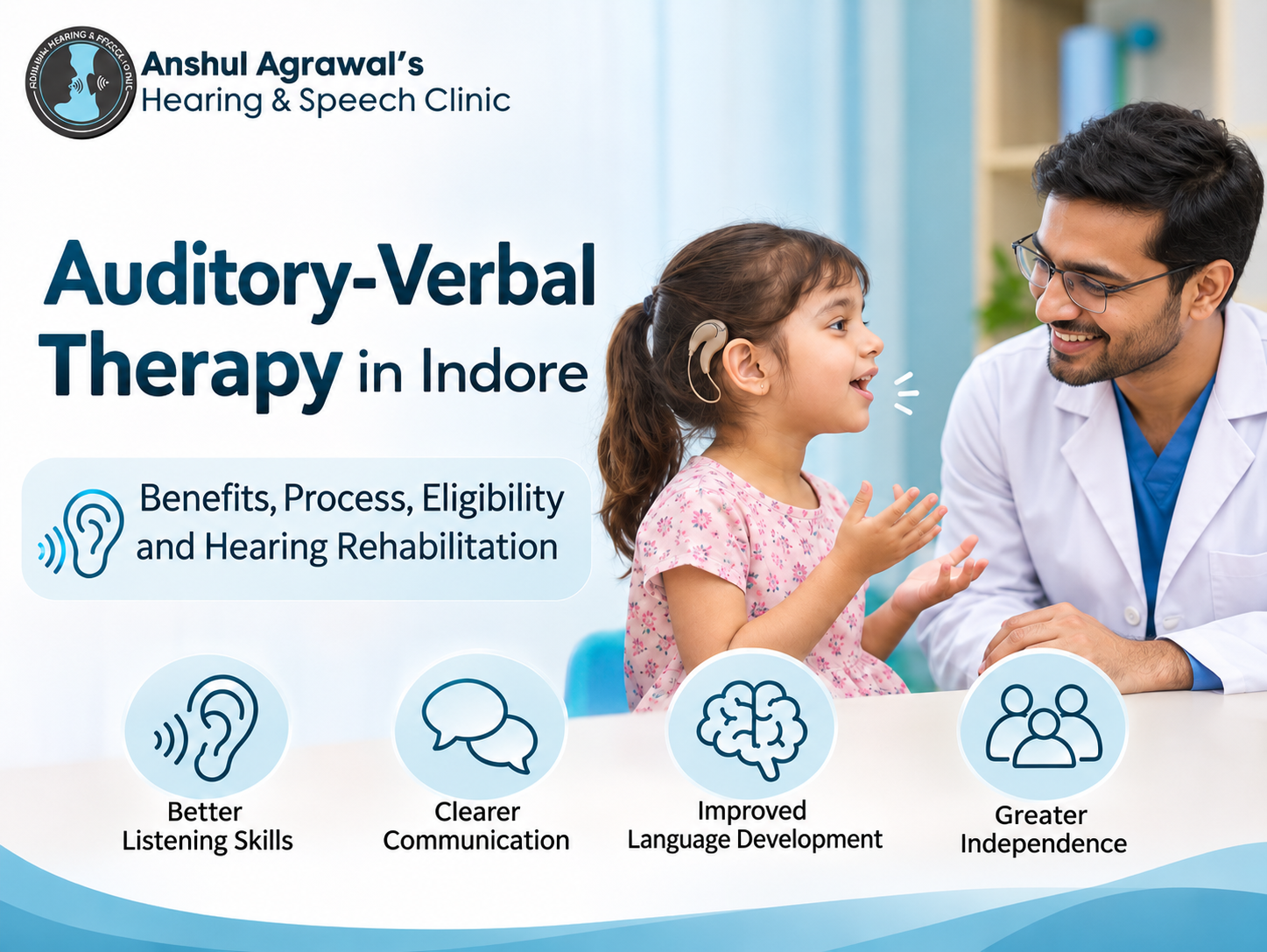
Auditory-Verbal Therapy in Indore is a specialised approach that helps children with hearing loss develop listening and spoken-language skills by making effective use of their available hearing. The therapy focuses on teaching children to listen, understand sounds, develop speech and communicate through spoken language.
For children with hearing loss, early intervention can be particularly important because the early years are a significant period for auditory, language and communication development. Auditory-Verbal Therapy, commonly called AVT, uses structured listening activities and active participation from parents or caregivers.
At Agrawal Speech & Hearing Clinic, Anshul Agrawal provides hearing and speech-related assessment and therapy for children, adults and senior patients. The clinic focuses on hearing assessment, speech development, auditory rehabilitation, stuttering, speech delay and cochlear implant counselling.
What Is Auditory-Verbal Therapy?
Auditory-Verbal Therapy is a family-centred intervention designed to help children with hearing loss learn to listen and develop spoken communication. Instead of relying primarily on visual communication, AVT encourages the child to use appropriately supported hearing through hearing aids, cochlear implants or other hearing technology.
The therapy may help a child learn to:
- Detect environmental sounds
- Recognise speech sounds
- Differentiate between sounds
- Understand spoken words
- Develop listening attention
- Follow spoken instructions
- Build vocabulary
- Develop clearer speech
- Participate in conversations
- Improve communication confidence
The exact therapy programme depends on the child’s age, hearing level, hearing technology, language development and individual needs. Auditory-Verbal Therapy in South Tukoganj, Indore can therefore involve much more than simply repeating words. It is a structured process that teaches children to make meaningful use of auditory information.
Who Can Benefit From Auditory-Verbal Therapy?
AVT is particularly associated with children who have hearing loss and are using hearing technology that provides access to sound.
Potential candidates may include children with:
- Congenital hearing loss
- Early-onset hearing loss
- Hearing loss identified through newborn screening
- Children using hearing aids
- Children with cochlear implants
- Children who have received cochlear implantation
- Delayed auditory development
- Delayed speech and language development associated with hearing loss
The suitability of AVT should be determined after a detailed hearing and developmental assessment. Parents looking for AVT for Hearing Loss in Vijay Nagar, Indore should first understand the child’s hearing profile and whether the hearing technology is providing adequate access to speech sounds. AVT is not automatically appropriate for every child with communication difficulties. Children with speech delay caused by other developmental, neurological or language-related factors may require a different or additional therapeutic approach.
Why Early Auditory Intervention Matters
Hearing plays an important role in how children naturally learn spoken language. A child with significant hearing loss may have limited access to speech sounds. Without appropriate intervention, this can affect vocabulary development, speech production and communication skills.
Early identification provides an opportunity to assess hearing and begin appropriate intervention.
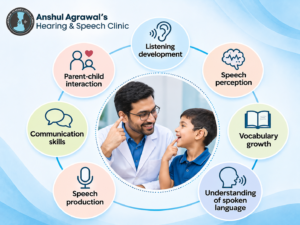
Early auditory intervention may support:
- Listening development
- Speech perception
- Vocabulary growth
- Understanding of spoken language
- Speech production
- Communication skills
- Parent-child interaction
Auditory-Verbal Therapy for Children in Palasia, Indore can be structured according to the child’s developmental stage rather than simply using the same exercises for every child.
How Does Auditory-Verbal Therapy Work?
Auditory-Verbal Therapy generally follows a structured listening-based approach. The therapist creates activities that encourage the child to pay attention to sound and understand its meaning.
1. Sound Awareness
The child first learns to notice different sounds.
These may include:
- Environmental sounds
- Voices
- Musical sounds
- Household sounds
- Speech sounds
2. Sound Discrimination
The child learns to identify differences between sounds.
For example, therapy may gradually help a child distinguish between different speech sounds or words.
3. Word Recognition
Once auditory discrimination develops, activities may focus on recognising familiar words.
4. Understanding Spoken Language
The child gradually learns to understand words, phrases, instructions and conversations.
5. Spoken Communication
The ultimate focus is functional communication, where the child uses spoken language to interact with family members, teachers and peers.
Role of Parents in Auditory-Verbal Therapy
Parents play an important role in AVT. Therapy sessions alone cannot provide all the listening experiences a child needs. Children learn language through repeated interactions throughout their everyday lives.
Parents may be guided to:
- Speak naturally with the child
- Use everyday conversations
- Encourage listening
- Repeat important words when necessary
- Create opportunities for the child to respond
- Use appropriate auditory strategies
- Monitor hearing-device use
- Practise activities recommended by the therapist
Hearing Rehabilitation Therapy near Geeta Bhawan, Indore may therefore include guidance for parents so that therapeutic listening activities can continue beyond the clinic.
This family participation can help integrate listening and spoken-language practice into normal routines such as eating, playing, dressing, reading and travelling.
AVT and Hearing Aids
Hearing aids can amplify sound for people with hearing loss, but simply wearing a hearing aid does not automatically teach a child how to interpret speech. A child may need time and structured auditory practice to understand the sounds being amplified. AVT can help children learn to make functional use of their available hearing.
Therapy may involve:
- Detecting amplified sounds
- Listening to speech
- Identifying words
- Understanding differences in speech sounds
- Building auditory memory
- Developing language through listening
AVT for Hearing Loss in Vijay Nagar, Indore should be planned alongside appropriate audiological assessment and hearing-device management. If hearing aids are not functioning correctly or are not appropriately fitted, auditory therapy may become less effective. Regular audiological monitoring is therefore important.
Auditory-Verbal Therapy and Cochlear Implants
Cochlear implants provide auditory stimulation differently from conventional hearing aids. After implantation and activation, the child generally needs time and structured rehabilitation to learn to interpret the new auditory information. Auditory-Verbal Therapy can be an important component of rehabilitation for some children using cochlear implants.
The therapy may focus on:
- Detecting new sounds
- Identifying speech
- Building auditory memory
- Understanding spoken language
- Developing vocabulary
- Improving speech production
- Using listening skills in everyday situations
AV Therapy for Cochlear Implant Children near Bengali Square, Indore may involve close coordination between the family, audiologist, therapist and other professionals involved in the child’s rehabilitation. The rehabilitation process differs from child to child.
What Happens During an AVT Session?
An AVT session is usually structured around the child’s developmental level and listening abilities.
A session may involve:
Listening Games
Games can encourage children to identify sounds, words or instructions while keeping therapy engaging.
Story-Based Activities
Stories can introduce vocabulary and provide opportunities for listening comprehension.
Everyday Communication
The therapist may use familiar situations to encourage functional spoken communication.
Auditory Memory Exercises
Children may be asked to remember and respond to words, phrases or sequences.
Parent Coaching
Parents may observe activities and learn how to continue appropriate listening practice at home.
Auditory-Verbal Therapy in Indore should be adapted according to the child’s progress rather than following a fixed programme for every patient.
Auditory-Verbal Therapy for Speech Delay
Hearing loss is one possible factor associated with delayed speech and language development.
When a child has reduced access to spoken language, they may have difficulty learning:
- New words
- Sentence structures
- Speech sounds
- Listening comprehension
- Conversational patterns
However, speech delay can have many causes. Therefore, children with delayed speech should undergo appropriate assessment rather than assuming that hearing loss is the only explanation.
Speech and Hearing Therapy in Saket Nagar, Indore may involve hearing assessment, speech-language evaluation and therapy planning depending on the child’s individual presentation.
Listening and Spoken Language Development
Listening and spoken language development generally progresses gradually.
A child may initially learn to notice sounds before progressing toward:
- Sound awareness
- Sound discrimination
- Sound identification
- Word understanding
- Phrase comprehension
- Sentence understanding
- Conversational communication
The pace can vary considerably.
Listening and Spoken Language Therapy in Rau, Indore may therefore use age-appropriate activities while considering the child’s hearing level, hearing technology and existing language abilities.
Progress should be monitored using appropriate developmental and communication measures.
Auditory-Verbal Therapy for Young Children
Young children often learn through play and everyday interaction.
Therapy may use:
- Toys
- Picture books
- Songs
- Simple instructions
- Familiar objects
- Turn-taking activities
- Sound imitation
- Parent-child games
For example, a therapist may encourage a child to listen for the word “ball,” locate the object and respond appropriately.
Over time, simple activities can become more complex as the child’s auditory and language skills develop.
Pediatric Hearing Therapy near MG Road Indore, Indore may be appropriate for families seeking early intervention for children with hearing-related communication difficulties.
How Is Progress Measured?
Auditory-verbal rehabilitation should involve regular assessment.
Progress may be evaluated through:
- Hearing assessments
- Speech perception testing
- Listening responses
- Vocabulary development
- Language comprehension
- Speech production
- Communication in everyday situations
- Parent observations
- School-related communication
The specific assessment tools depend on the child’s age and clinical requirements.
Progress may not always occur at the same rate in every area. A child may improve in sound detection before showing substantial improvement in conversational language.
How Long Does Auditory-Verbal Therapy Take?
There is no universal duration for AVT.
The length of therapy can depend on:
- Age at identification of hearing loss
- Degree and type of hearing loss
- Age when hearing technology was introduced
- Consistency of device use
- Child’s developmental profile
- Language exposure
- Family participation
- Individual learning progress
Some children may require intensive early intervention, while others may transition to less frequent therapy as their listening and spoken-language abilities develop.
Regular reassessment helps determine whether therapy goals need to be modified.
Importance of Consistent Hearing Device Use
For children using hearing aids or cochlear implants, consistent access to appropriately functioning hearing technology is an important part of auditory development.
Parents should monitor:
- Whether the device is being worn
- Device condition
- Battery or charging status
- Changes in hearing behaviour
- Device alerts
- Scheduled audiological follow-ups
If a child suddenly stops responding to sounds or appears to hear less effectively, the hearing device should be checked by an appropriate professional.
AV Therapy for Cochlear Implant Children near Bengali Square, Indore works most effectively when the child’s hearing technology is appropriately programmed and maintained.
Auditory-Verbal Therapy and School Readiness
Listening and spoken-language abilities can influence a child’s ability to participate in educational environments.
Children may need to understand:
- Teacher instructions
- Classroom discussions
- Questions
- Stories
- Group conversations
- Peer communication
AVT can support development of listening and spoken communication, although educational support should be tailored to the child’s needs.
Teachers and parents can also work together to identify situations where the child may have difficulty hearing or understanding speech.
Benefits of Auditory-Verbal Therapy
When appropriate for a child, AVT may support development in several areas.
Improved Listening Skills
Children learn to pay attention to and interpret auditory information.
Spoken Language Development
Regular listening exposure can support vocabulary and language development.
Speech Development
Children may develop improved awareness and production of speech sounds.
Communication
The therapy encourages practical use of spoken communication.
Family Participation
Parents learn strategies that can be integrated into daily activities.
Educational Participation
Improved listening and language skills may help children participate more effectively in classroom communication.
These outcomes vary among children and depend on several factors.
Auditory-Verbal Therapy vs Speech Therapy
AVT and conventional speech therapy are not necessarily interchangeable.
Auditory-Verbal Therapy specifically emphasises learning through listening and spoken language, particularly for children with hearing loss who have access to appropriate hearing technology.
Speech therapy is a broader field that addresses conditions such as:
- Speech sound disorders
- Language disorders
- Stuttering
- Voice disorders
- Developmental communication difficulties
- Motor speech problems
Some children may benefit from both approaches.
A proper assessment can determine which therapy or combination of therapies is appropriate.
When Should Parents Seek an Evaluation?
Parents should consider a hearing and communication assessment when they notice:
- Limited response to sounds
- Delayed speech
- Difficulty understanding spoken instructions
- Unclear speech
- Frequent requests for repetition
- Difficulty hearing in noisy environments
- Delayed vocabulary development
- Lack of progress despite hearing-device use
- Concerns about hearing-aid or cochlear-implant performance
Early evaluation can help identify whether hearing loss or another developmental issue is affecting communication.
Auditory-Verbal Therapy for Children in Palasia, Indore may be considered after appropriate hearing and communication assessment.
About Anshul Agrawal and Agrawal Speech & Hearing Clinic
Anshul Agrawal is associated with Agrawal Speech & Hearing Clinic, located in South Tukoganj, Indore, near Nath Mandir Road.
According to the supplied clinic information, the practice focuses on hearing and speech care for children, adults and senior patients.
Areas of care include:
- Hearing assessment
- Hearing loss management
- Speech delay
- Stuttering
- Speech therapy
- Cochlear implant counselling
- Auditory rehabilitation
- Pediatric hearing support
- Communication development
The clinic uses hearing assessment and diagnostic tools as part of its approach to identifying hearing and communication difficulties.
The supplied profile describes Anshul Agrawal as having more than 10 years of overall experience and clinical experience in hearing and speech care.
Who Provides Auditory-Verbal Therapy?
Auditory-Verbal Therapy is generally delivered by professionals with specialised training in auditory-based rehabilitation and spoken-language development.
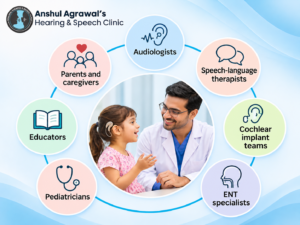
Depending on the child’s needs, care may involve coordination between:
- Audiologists
- Speech-language therapists
- Cochlear implant teams
- ENT specialists
- Pediatricians
- Educators
- Parents and caregivers
A multidisciplinary approach can be useful when a child has complex hearing, speech or developmental requirements.
Hearing Rehabilitation Therapy near Geeta Bhawan, Indore may therefore involve collaboration between hearing assessment and communication therapy rather than treating these areas independently.
Creating a Listening-Friendly Home
Parents can support auditory development by creating opportunities for meaningful listening throughout the day.
Simple activities include:
During Meals
Talk about food, utensils and daily activities.
During Play
Name toys and encourage the child to listen and respond.
During Reading
Read short stories and ask simple questions.
During Travel
Talk about sounds, vehicles and surroundings.
During Household Activities
Use everyday activities to introduce vocabulary.
The objective is not to turn every moment into a formal therapy session. Instead, parents can naturally incorporate listening and spoken-language opportunities into everyday interactions.
Common Challenges During Auditory-Verbal Therapy
Families may encounter several challenges.
Limited Attention
Young children may lose interest quickly. Activities often need to be short and engaging.
Slow Language Development
Some children require extended periods of auditory and language practice.
Device-Related Problems
Poor device function or inconsistent use can affect auditory access.
Family Adjustment
Parents may need time to learn new communication strategies.
Different Developmental Needs
Children do not all respond to therapy in the same way.
Regular assessment and adjustment of therapy goals can help address these challenges.
Frequently Asked Questions – Auditory-Verbal Therapy in Indore
1. Is AVT suitable for every child with hearing loss?
No. Suitability depends on factors such as the child’s hearing level, access to sound, hearing technology, developmental profile and family goals. A professional assessment is needed before establishing an AVT programme.
2. Can AVT help a child who already uses a cochlear implant?
Yes, AVT can be part of rehabilitation for some children using cochlear implants. The therapy helps them learn to interpret and use auditory information for listening and spoken communication.
3. Does AVT replace a hearing aid or cochlear implant?
No. AVT is a rehabilitation approach. It does not replace hearing technology. Appropriate hearing access and regular audiological monitoring are important components of the overall process.
4. Can parents participate during therapy sessions?
Yes. Parent participation is an important feature of many auditory-based intervention programmes. Parents can learn strategies that can be incorporated into everyday communication.
5. Is AVT only for babies?
No. Although early intervention can be particularly valuable, children of different ages may receive auditory-based rehabilitation depending on their hearing and communication needs.
6. Can AVT improve speech clarity?
It may support speech and language development in children who have access to sound and are appropriate candidates. However, outcomes vary and depend on individual factors.
7. How often should AVT sessions be attended?
The frequency depends on the child’s age, hearing status, developmental needs and therapy goals. The treating professional determines an appropriate schedule.
8. What should parents do if a child refuses to wear a hearing device?
Parents should investigate why the child is refusing the device. Discomfort, poor fit, sound quality or behavioural factors may be involved. The device should be checked by an appropriate hearing professional.
9. Can AVT help with speech delay when hearing is normal?
AVT specifically focuses on auditory-based intervention for children with hearing-related needs. A child with normal hearing and speech delay may require a different speech-language assessment and therapy plan.
10. Is home practice important?
Yes. Everyday listening and communication provide valuable opportunities for children to use the skills introduced during therapy. Home activities should follow the strategies recommended by the child’s therapist.
Conclusion – Auditory-Verbal Therapy in Indore
Auditory-Verbal Therapy in Indore provides a structured pathway for children with hearing loss to develop listening, spoken-language and communication abilities when they are appropriate candidates for an auditory-based approach. The process combines professional therapy, appropriate hearing technology, regular assessment and active family participation. From sound awareness and speech perception to vocabulary, comprehension and everyday communication, therapy goals can evolve as the child develops.
Families looking for Auditory-Verbal Therapy in South Tukoganj, Indore, AVT for Hearing Loss in Vijay Nagar, Indore, or Auditory-Verbal Therapy for Children in Palasia, Indore should begin with a detailed hearing and communication assessment. Similarly, children requiring Hearing Rehabilitation Therapy near Geeta Bhawan, Indore, Speech and Hearing Therapy in Saket Nagar, Indore, or AV Therapy for Cochlear Implant Children near Bengali Square, Indore may benefit from an individually structured rehabilitation plan.
For families exploring Listening and Spoken Language Therapy in Rau, Indore or Pediatric Hearing Therapy near MG Road Indore, Indore, early professional evaluation can help identify the child’s current listening and communication abilities and determine appropriate next steps. The central goal of auditory-based rehabilitation is not simply producing sounds. It is helping a child make meaningful use of available hearing to understand, communicate and participate more effectively in everyday life.