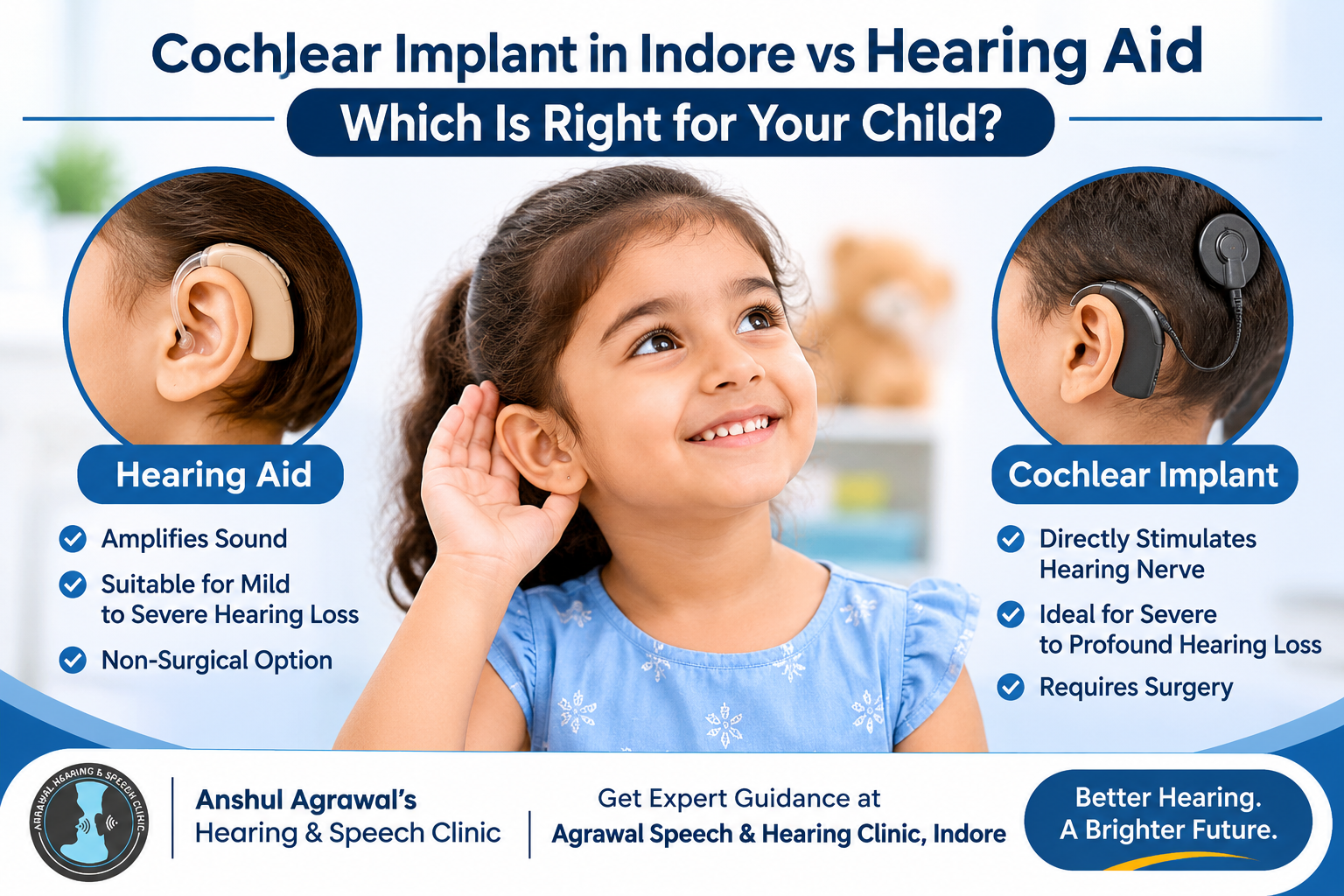
If your child has hearing loss, you may be wondering whether a hearing aid or a cochlear implant is the better option. Both devices can help a child hear sounds, develop speech, and learn language, but they work in different ways and are recommended for different levels of hearing loss.
A cochlear implant in Indore may be considered for children with severe to profound sensorineural hearing loss who do not receive enough benefit from hearing aids. A hearing aid, on the other hand, may be suitable for children with mild to severe hearing loss, depending on the type and degree of loss.
At Agrawal Speech & Hearing Clinic, parents can receive guidance on hearing evaluation, hearing aid fitting, auditory-verbal therapy, and speech therapy for children with hearing loss. The right treatment depends on a detailed hearing test, the child’s age, the degree of hearing loss, and the family’s communication goals.
This guide explains the difference between a cochlear implant and a hearing aid, when each option may be recommended, and how parents can make an informed decision.
What Is a Hearing Aid?
A hearing aid is a small electronic device worn in or behind the ear. It picks up sound, amplifies it, and delivers it into the ear canal. Hearing aids are commonly used for children and adults with sensorineural, conductive, or mixed hearing loss, depending on the individual case.
A hearing aid in Indore can help a child hear speech, environmental sounds, music, and everyday communication more clearly. For many children, hearing aids are the first step in supporting listening and language development.
Hearing aids do not restore normal hearing. Instead, they make sounds louder and clearer so the child can use their remaining hearing more effectively. The benefit depends on the degree and type of hearing loss, the fit of the device, and consistent use.
At a professional hearing aid clinic in Indore, an audiologist will assess the child’s hearing and recommend the most suitable device and settings.
What Is a Cochlear Implant?
A cochlear implant is a medical device that bypasses damaged parts of the inner ear and directly stimulates the hearing nerve. It consists of an external sound processor and an internal implant placed under the skin behind the ear.
Unlike a hearing aid, which amplifies sound, a cochlear implant converts sound into electrical signals and sends them directly to the auditory nerve. This can help children with severe to profound sensorineural hearing loss who receive limited benefit from powerful hearing aids.
A cochlear implant in Indore does not instantly restore normal hearing. After surgery and activation, the child needs time, training, and rehabilitation to learn how to interpret the new sound signals. Auditory-verbal therapy and speech therapy play an important role in this journey.
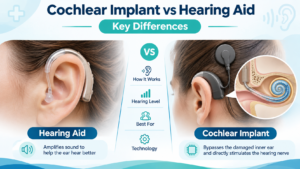
Cochlear Implant vs Hearing Aid: Key Differences
Understanding the difference between a cochlear implant and a hearing aid can help parents make a more informed decision.
| Feature | Hearing Aid | Cochlear Implant |
| How it works | Amplifies sound | Bypasses damaged inner ear and stimulates the hearing nerve |
| Suitable for | Mild to severe hearing loss, depending on the case | Severe to profound sensorineural hearing loss with limited hearing aid benefit |
| Surgery | No surgery required | Requires surgical implantation |
| External device | Worn in or behind the ear | External sound processor worn behind the ear |
| Internal component | No internal implant | Internal implant placed under the skin |
| Activation | Immediate after fitting | Requires activation and mapping after surgery |
| Rehabilitation | Auditory training and speech therapy may help | Auditory-verbal therapy and speech therapy are usually important |
| Maintenance | Battery or rechargeable device care | Processor care, battery management, and mapping sessions |
A qualified audiologist in Indore can help parents understand which option is medically appropriate for their child. The decision is not based on personal preference alone; it depends on hearing test results, medical evaluation, and the child’s response to hearing aids.
When Is a Hearing Aid Right for a Child?
A hearing aid in Indore may be recommended when a child has hearing loss that can be supported with amplification. Many children with mild, moderate, or severe hearing loss benefit from hearing aids, especially when they are fitted early and used consistently.
A hearing aid may be suitable if your child:
- Has mild to severe hearing loss
- Shows benefit from amplified sound during a hearing aid trial
- Has some usable residual hearing
- Needs support for speech and language development
- Can use the device consistently with family support
- Is not yet a candidate for a cochlear implant
- Needs hearing support while further evaluation is ongoing
Early fitting of a hearing aid can help a child access speech and language during the critical years of brain development. A pediatric audiologist in Indore can recommend the right device, adjust the settings, and monitor the child’s progress over time.
When Is a Cochlear Implant Recommended for a Child?
A cochlear implant in Indore may be considered when a child has severe to profound sensorineural hearing loss and does not receive sufficient benefit from hearing aids. The decision is made after detailed testing and evaluation by an audiologist, ENT specialist, and sometimes a cochlear implant team.
A cochlear implant may be recommended if your child:
- Has severe to profound sensorineural hearing loss
- Receives limited benefit from appropriately fitted hearing aids
- Has difficulty developing speech and language despite hearing aid use
- Is medically suitable for surgery
- Has supportive family involvement for rehabilitation
- Can participate in auditory-verbal therapy and follow-up care
- Needs access to sound for speech, language, and educational development
Cochlear implants are not suitable for every type of hearing loss. For example, some children with conductive hearing loss or certain medical conditions may need a different treatment approach. A detailed evaluation at a trusted hearing aid clinic in Indore is essential before deciding.
Hearing Loss in Children: Why Early Diagnosis Matters
Early identification of hearing loss is important because children learn speech and language by listening to sounds, words, and voices around them. When hearing loss is not addressed early, it can affect speech development, language skills, learning, and social communication.
Signs that may suggest hearing loss in a child include:
- Not responding to their name
- Not turning toward sounds
- Delayed speech or limited vocabulary
- Difficulty following instructions
- Speaking loudly or unclearly
- Needing repetition
- Turning up the volume on TV or devices
- Poor performance in school
- Limited attention during conversations
If you notice any of these signs, schedule a hearing evaluation with an experienced audiologist in Indore. Early diagnosis allows the family to choose the right hearing solution and begin rehabilitation at the right time.

Hearing Test for Children: How Audiologists Decide
Before recommending a hearing aid or a cochlear implant, an audiologist will perform a detailed hearing evaluation. The type of test depends on the child’s age and developmental level.
Common hearing tests for children include:
- Behavioral observation audiometry
- Visual reinforcement audiometry
- Play audiometry
- Pure tone audiometry
- Tympanometry
- Otoacoustic emissions
- Auditory brainstem response, when required
These tests help determine the type, degree, and configuration of hearing loss. The results also help the audiologist decide whether a hearing aid, cochlear implant evaluation, or further medical referral is needed.
At Agrawal Speech & Hearing Clinic, hearing evaluation is designed to understand the child’s hearing needs and recommend the most suitable treatment path.
Cochlear Implant Surgery for Children: What Parents Should Know
Cochlear implant surgery is performed under anesthesia by an ENT surgeon or cochlear implant surgeon. The internal device is placed under the skin behind the ear, while the external sound processor is worn externally.
After surgery, the implant is usually activated after a healing period. The audiologist then programs and maps the device to suit the child’s hearing needs. Mapping may require several follow-up sessions as the child adjusts to the new sound.
Parents should understand that a cochlear implant is not a one-time treatment. It is the beginning of a rehabilitation journey that includes regular follow-up, device care, auditory training, and language development support.
A cochlear implant in Indore works best when it is combined with consistent use, family involvement, and appropriate therapy.
Auditory-Verbal Therapy After Hearing Aids or Cochlear Implants
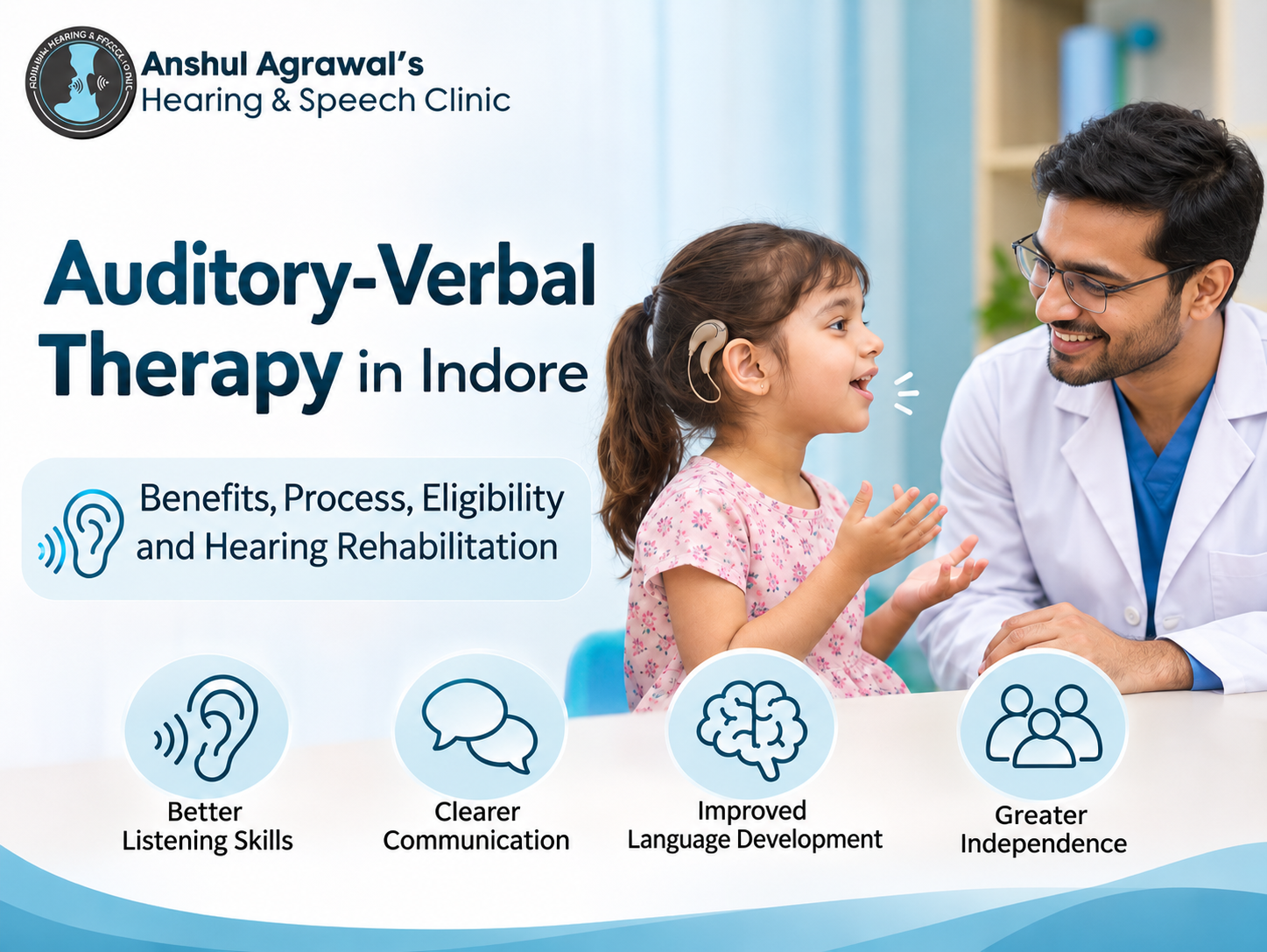
Whether a child uses a hearing aid or a cochlear implant, rehabilitation is essential. Auditory-verbal therapy helps children learn to listen, understand speech, and develop spoken language through their hearing devices.
Auditory-verbal therapy may help a child:
- Detect and identify sounds
- Understand speech
- Develop vocabulary
- Improve speech clarity
- Build sentence formation
- Improve communication skills
- Participate in school and social activities
At Agrawal Speech & Hearing Clinic, auditory-verbal therapy is provided for children with hearing loss who use hearing aids or cochlear implants. The goal is to help children make the best use of their hearing technology and develop communication skills.
Speech Therapy in Indore for Children with Hearing Loss
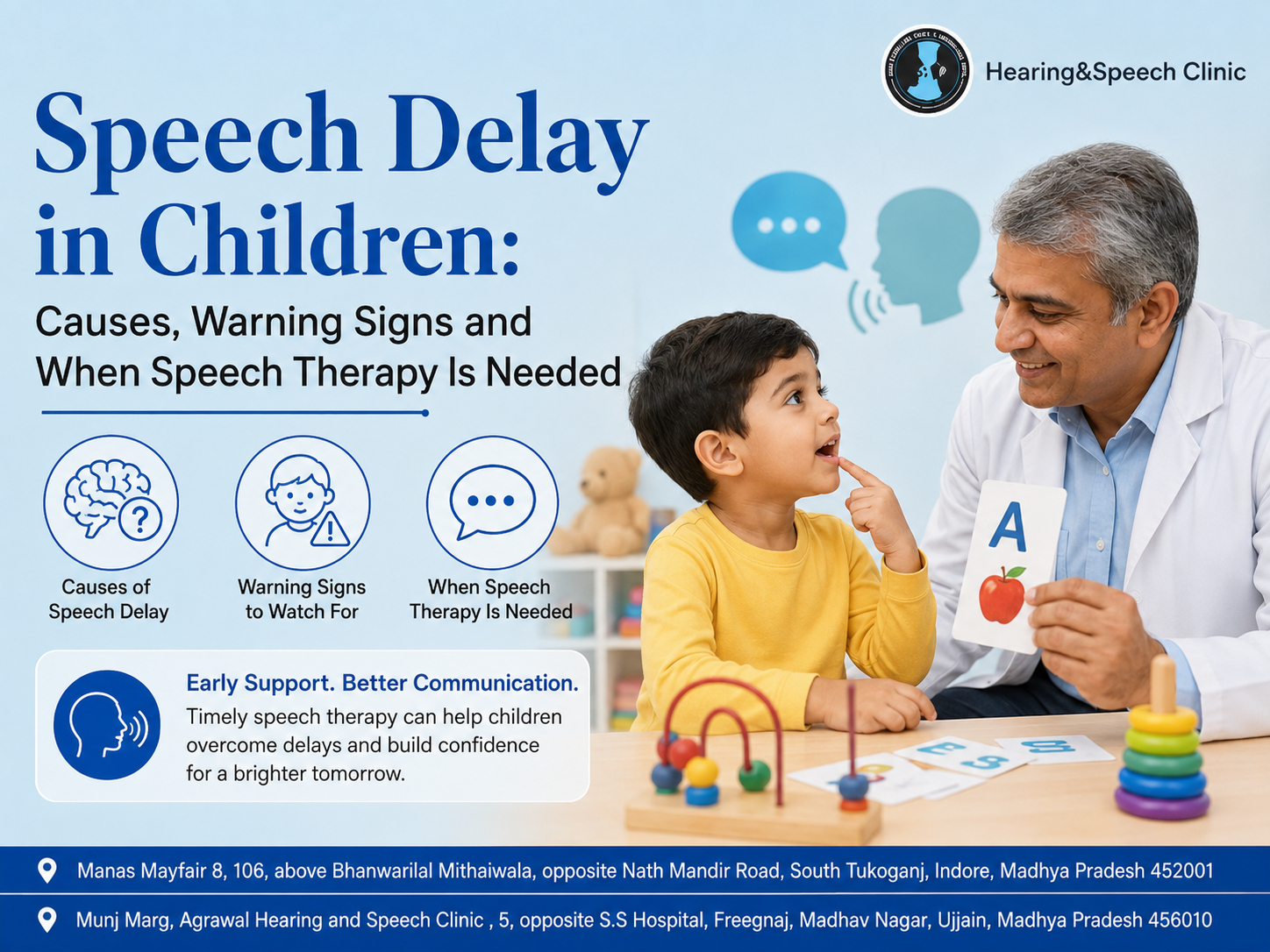
Many children with hearing loss also need speech therapy to develop clear speech, language skills, and communication confidence. Speech therapy in Indore can support children who have delayed speech, unclear pronunciation, limited vocabulary, or difficulty forming sentences.
Speech therapy may focus on:
- Listening skills
- Speech sound production
- Vocabulary development
- Sentence formation
- Language comprehension
- Social communication
- Voice and fluency
- Parent coaching for home practice
A speech-language pathologist works alongside the audiologist to create a plan that supports the child’s hearing, speech, and language development. Early and consistent therapy can make a meaningful difference in a child’s communication journey.
Cochlear Implant vs Hearing Aid: Cost and Maintenance
Cost is an important consideration for many families. A hearing aid in Indore usually has a lower initial cost than a cochlear implant, but the total cost depends on the device technology, features, battery type, and follow-up services.
A cochlear implant in Indore involves the cost of surgery, the implant device, external processor, mapping sessions, and long-term rehabilitation. Insurance coverage, government schemes, and hospital policies may affect the final cost, so families should discuss this with their cochlear implant team.
Both options require ongoing care:
- Regular hearing check-ups
- Device cleaning and maintenance
- Battery or rechargeable care
- Software updates and programming
- Follow-up therapy sessions
- Monitoring speech and language progress
An experienced audiologist in Indore can guide families on realistic expectations, device care, and long-term support.
How to Choose the Best Hearing Solution for Your Child
Choosing between a cochlear implant and a hearing aid can feel overwhelming. The best choice depends on the child’s hearing loss, age, response to hearing aids, medical fitness, and family goals.
A good hearing aid clinic in Indore will not pressure parents into one option. Instead, it will provide clear information, perform appropriate testing, and involve the family in every decision.
At Agrawal Speech & Hearing Clinic, parents receive guidance on hearing evaluation, hearing aid fitting, cochlear implant rehabilitation, auditory-verbal therapy, and speech therapy. The clinic focuses on long-term communication development, not just device selection.hearandspeech+2
Book a Hearing Evaluation in Indore
If your child has hearing loss, delayed speech, or difficulty responding to sound, do not wait. Early evaluation can help identify the degree and type of hearing loss and guide the right treatment path.
To discuss whether a cochlear implant in Indore or a hearing aid in Indore is right for your child, book a consultation at Agrawal Speech & Hearing Clinic. An experienced audiologist in Indore can assess your child’s hearing and recommend the most suitable plan.
Early support, appropriate hearing technology, and consistent speech therapy in Indore can help children with hearing loss develop listening, speech, language, and communication skills.
FAQs
What is the difference between a cochlear implant and a hearing aid?
A hearing aid amplifies sound, while a cochlear implant bypasses damaged parts of the inner ear and directly stimulates the hearing nerve.
When does a child need a cochlear implant?
A cochlear implant may be considered when a child has severe to profound sensorineural hearing loss and receives limited benefit from hearing aids.
Can a child use a hearing aid before a cochlear implant?
Yes. Many children use hearing aids first. If the benefit is limited, a cochlear implant evaluation may be recommended.
Is a cochlear implant suitable for all types of hearing loss?
No. The suitability depends on the type and degree of hearing loss, medical evaluation, and the child’s response to hearing aids.
Does a cochlear implant restore normal hearing?
No. A cochlear implant provides access to sound, but the child needs time, training, and rehabilitation to develop listening and speech skills.
Is auditory-verbal therapy needed after a cochlear implant?
Yes. Auditory-verbal therapy is often an important part of rehabilitation after cochlear implantation.
What is the cost of a cochlear implant in India?
The cost depends on the implant device, surgery, hospital, mapping sessions, and rehabilitation. Families should discuss this with their cochlear implant team.
Who is the best audiologist for children with hearing loss in Indore?
For hearing evaluation, hearing aid fitting, and cochlear implant rehabilitation guidance, parents can consult Agrawal Speech & Hearing Clinic and an experienced audiologist in Indore.