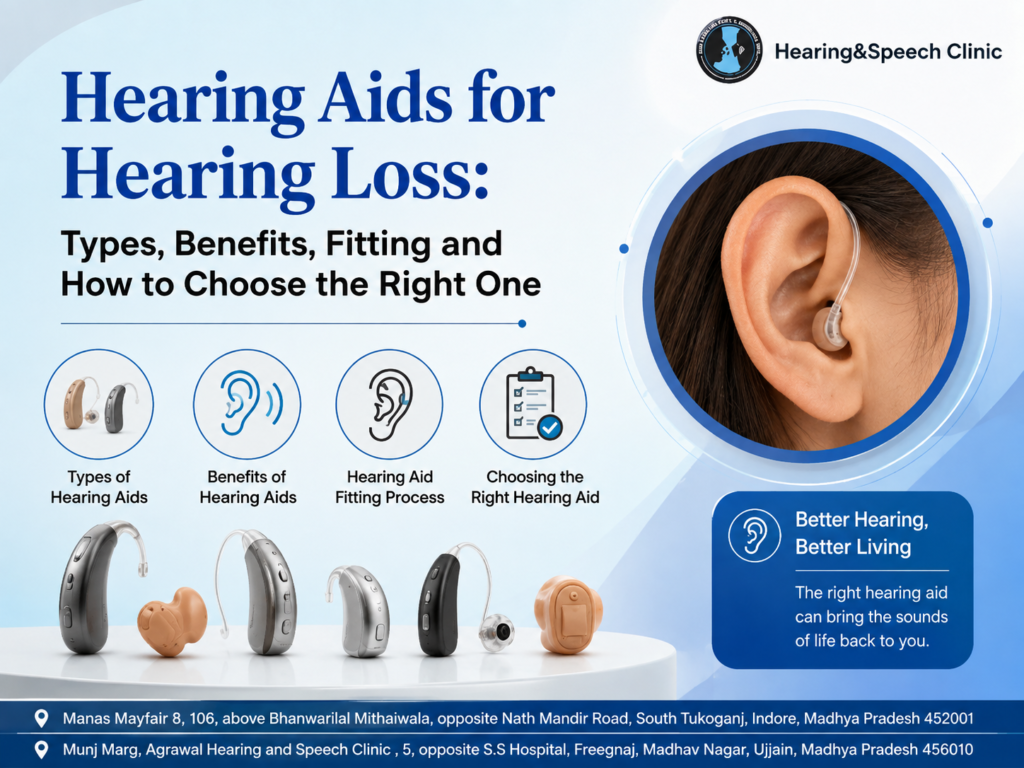
Hearing Aids for Hearing Loss: Types, Benefits, Fitting and How to Choose the Right One
Have you started asking people to repeat themselves, increasing the volume of your television, or struggling to follow conversations in crowded places? Hearing loss can gradually affect communication, social interaction, work, and everyday independence. For many people with suitable types of hearing loss, a hearing aid can make speech and environmental sounds easier to hear. However, choosing a hearing aid is not simply about selecting the smallest or most expensive device. The right choice depends on the degree and type of hearing loss, lifestyle, listening needs, comfort, ear anatomy, and professional fitting. For individuals searching for a Hearing Aid in Indore, professional hearing assessment should ideally come before selecting a device. An audiologist can determine the type and severity of hearing loss and help identify whether hearing aids are appropriate. Modern devices can provide features such as automatic sound processing, directional microphones, noise management, rechargeable batteries, and wireless connectivity, but these features are useful only when they match the user’s actual hearing and communication requirements. At Agrawal Hearing and Speech Clinic, Anshul Agrawal, an experienced audiologist, provides hearing assessment and hearing-care guidance for children, adults, and senior patients. Located in South Tukoganj near Nath Mandir Road, the clinic focuses on detailed assessment, modern diagnostic tools, hearing rehabilitation, and patient-friendly guidance. Understanding the available hearing aid types, fitting process, trial period, adjustment, and maintenance can help patients make a more informed decision. What Is a Hearing Aid and How Does It Help With Hearing Loss? A hearing aid is a small electronic device designed to make certain sounds louder and more accessible to a person with hearing loss. Most hearing aids contain a microphone, processing or amplification system, and speaker or receiver. The microphone picks up surrounding sounds, the device processes them, and the receiver delivers the processed sound to the ear. A Hearing Aid in Indore may help people hear conversations, television, doorbells, environmental sounds, and other important auditory information more easily. However, hearing aids do not restore normal hearing or completely eliminate all difficulties in noisy environments. Their effectiveness depends on the type and severity of hearing loss, appropriate programming, consistent use, and realistic expectations. Who May Benefit From a Hearing Aid? Not everyone with hearing difficulty requires the same type of hearing device. Some people may have mild hearing loss, while others may have moderate, severe, or profound hearing loss requiring different amplification strategies. A hearing aid may be considered when hearing loss is affecting: Understanding conversations Telephone communication Workplace communication Family interactions Television listening Social participation Hearing in restaurants or groups Awareness of environmental sounds An audiological evaluation is important because hearing aids need to be selected and programmed according to the individual’s hearing profile. What Are the Different Types of Hearing Aids? There are several hearing aid styles, and Hearing Aid in Indore selection depends on factors such as hearing loss, ear anatomy, dexterity, lifestyle, comfort, and desired features. Common styles include: Behind-the-Ear (BTE) Hearing Aids BTE devices sit behind the ear and connect to an earmold, tubing, or another earpiece. They can be suitable for a wide range of hearing losses and are often valued for durability and ease of handling. Receiver-in-Canal (RIC) Hearing Aids RIC devices place the receiver closer to or inside the ear canal while the main body sits behind the ear. Their smaller design can make them appealing to many adults. In-the-Ear (ITE) Hearing Aids ITE devices are custom-made to fit within the outer ear. They can provide different levels of amplification depending on their design and the person’s hearing needs. In-the-Canal (ITC) Hearing Aids ITC devices sit partly inside the ear canal and are generally smaller than traditional ITE devices. Completely-in-Canal (CIC) Hearing Aids CIC devices fit deeply into the ear canal and can be less visible. However, their small size may make handling, cleaning, and battery replacement more difficult for some users. The most appropriate style should be selected after hearing assessment rather than based only on appearance. What Are Digital Hearing Aids and How Are They Different? Digital Hearing Aids in Indore use digital processing to analyze and modify incoming sounds before delivering them to the ear. Unlike traditional analog amplification, digital technology can provide more flexibility in processing different frequencies and listening environments. Modern digital hearing aids may offer features such as: Digital sound processing Directional microphones Noise management Feedback reduction Multiple listening programs Rechargeable batteries Smartphone connectivity Wireless audio streaming Not every person needs every available feature. The useful features depend on hearing loss, lifestyle, communication requirements, and personal preferences. Are Digital Hearing Aids Better Than Traditional Hearing Aids? Digital technology provides greater flexibility for programming and sound processing, but “better” depends on the user’s individual requirements. For someone who regularly participates in meetings, travels frequently, uses a smartphone, or spends time in noisy environments, certain digital features may be useful. Another person may primarily need straightforward amplification for conversations at home. The goal of Digital Hearing Aids in Indore should not be to select the device with the largest number of features. Instead, the device should provide appropriate amplification and useful features for the person’s actual listening needs. How Does an Audiologist Decide Which Hearing Aid Is Right for You? Choosing a Hearing Aid in Indore should begin with a comprehensive hearing evaluation. An audiologist assesses the degree and type of hearing loss and considers how it affects the person’s everyday communication. Important factors include: Degree of hearing loss Type of hearing loss Hearing in each ear Age Ear anatomy Communication requirements Lifestyle Workplace environment Manual dexterity Vision Smartphone use Cosmetic preferences Budget Ability to maintain the device An audiologist may also discuss whether one or two hearing aids are appropriate. For people with hearing loss in both ears who are candidates for amplification, two hearing aids may provide benefits for speech understanding and sound localization. Should You Wear One Hearing Aid or Two? If hearing loss affects both ears and both ears can benefit from amplification, two hearing aids are often considered. Hearing