
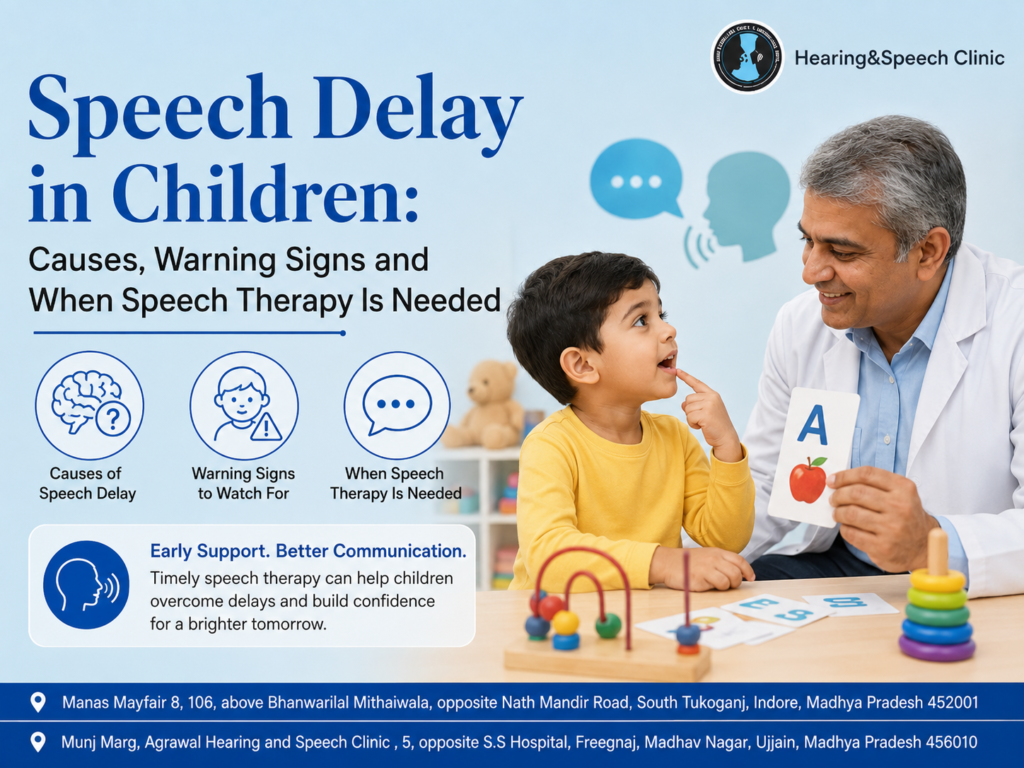
Speech Delay in Children: Causes, Warning Signs and When Speech Therapy Is Needed
Have you noticed that your child is not speaking as much as other children of the same age? Does your child understand what you say but struggle to express words clearly? Are you wondering whether late talking is a normal part of development or whether your child may need professional support? These are common concerns among parents. While children develop communication skills at different rates, persistent difficulty with speaking, understanding language, or communicating needs may indicate a speech or language delay. Seeking timely Speech Therapy in Indore can help identify the underlying concern and support better communication development. Speech delay does not always mean that a child has a serious medical problem. Sometimes children simply develop speech skills later than expected, while in other cases hearing difficulties, developmental differences, oral-motor problems, neurological conditions, or environmental factors may contribute to delayed communication. Early assessment is important because identifying the reason behind delayed speech can help parents understand what kind of support their child may need. At Agrawal Hearing and Speech Clinic, Anshul Agrawal, one of the Best Audiologist in Indore, provides hearing and speech assessment for children, adults, and seniors. His clinical approach combines detailed evaluation, modern diagnostic tools, and age-appropriate therapy to address concerns such as speech delay, stuttering, misarticulation, hearing loss, and communication difficulties. If your child is struggling to communicate according to their age, professional Speech Therapy in Indore can provide appropriate guidance and structured support. What Is Speech Delay and How Is It Different From Normal Speech Development? Speech delay means that a child is developing speech or language skills more slowly than expected for their age. A child may have difficulty saying words, forming sentences, understanding language, or communicating their needs. Some children may understand conversations well but speak very few words, while others may speak but have difficulty making themselves understood. It is important to understand that every child develops at a slightly different pace. However, developmental milestones provide general guidance about what communication skills are commonly expected at different ages. If a child consistently falls behind these milestones, an evaluation by an audiologist or speech-language professional can help determine whether support is required. Speech Therapy in Indore focuses on identifying specific communication difficulties and developing exercises and activities that are appropriate for the child’s age and abilities. What Are the Common Causes of Speech Delay in Children? Speech delay can occur for several different reasons. There is no single cause that applies to every child. A detailed assessment is therefore important before deciding on any therapy. Can Hearing Loss Cause Speech Delay in Children? Yes. Hearing plays a major role in speech and language development. A child needs to hear sounds clearly to learn how words are pronounced and how sentences are formed. Even mild or temporary hearing problems can sometimes affect communication development. Ear infections, fluid in the middle ear, congenital hearing problems, or other hearing-related conditions may interfere with the sounds a child receives. If hearing is reduced during important stages of language development, speech may be delayed. A hearing evaluation is often an important part of assessment before starting Speech Therapy in Indore, particularly when a child is not responding consistently to sounds, their name, or spoken instructions. Can Developmental Differences Lead to Speech Delay? Yes. Some children experience developmental differences that affect communication. They may take longer to develop vocabulary, sentence formation, social communication, or understanding of language. Developmental conditions can affect each child differently. Some children may have difficulty with expressive language, while others may have problems understanding what others say. Professional assessment helps parents understand the child’s specific communication profile rather than assuming that every speech delay has the same cause. Can Lack of Communication Opportunities Affect Speech Development? Children learn language through interaction. Talking, reading, singing, playing, and responding to a child’s attempts to communicate all provide opportunities to develop vocabulary and communication skills. Limited interaction or excessive passive screen exposure may reduce opportunities for meaningful communication in some children. However, parents should not assume that lack of interaction is the only cause of delayed speech. A professional assessment is important when concerns persist. Can Oral-Motor Problems Affect Speech? Some children have difficulty coordinating the muscles involved in speech. Problems involving the lips, tongue, jaw, or other oral structures may affect pronunciation and speech clarity. A speech-language professional can assess how effectively the child produces different sounds and whether oral-motor coordination may be contributing to communication difficulties. What Are the Warning Signs of Speech Delay Parents Should Never Ignore? Parents often notice speech delays before anyone else because they spend the most time with their children. Certain signs may indicate that an evaluation would be helpful. Some warning signs include: Very few spoken words compared with other children of the same age Difficulty combining words Difficulty understanding simple instructions Limited response to questions Difficulty communicating basic needs Speech that is difficult to understand Frequent use of gestures instead of words Loss of previously acquired language skills Difficulty copying sounds or words Limited attempts to communicate with others If you notice one or more of these signs consistently, it is better to seek professional guidance rather than simply waiting for the child to “catch up.” Early Speech Therapy in Indore can help identify specific areas of difficulty and provide structured activities to support communication development. At What Age Should a Child Start Talking? There is considerable variation in children’s speech development, but children generally acquire communication skills gradually from infancy through early childhood. Babies begin communicating through crying, eye contact, facial expressions, gestures, and vocal sounds. As they grow, they begin using recognizable words and gradually combine words into short phrases and sentences. Parents should pay attention not only to the number of words a child says but also to whether the child understands language, responds to communication, uses gestures, and attempts to interact with others. If a child’s communication development appears significantly behind their peers or previously acquired skills are lost, professional evaluation should not be