Auditory-Verbal Therapy in Indore: Benefits, Process, Eligibility and Hearing Rehabilitation
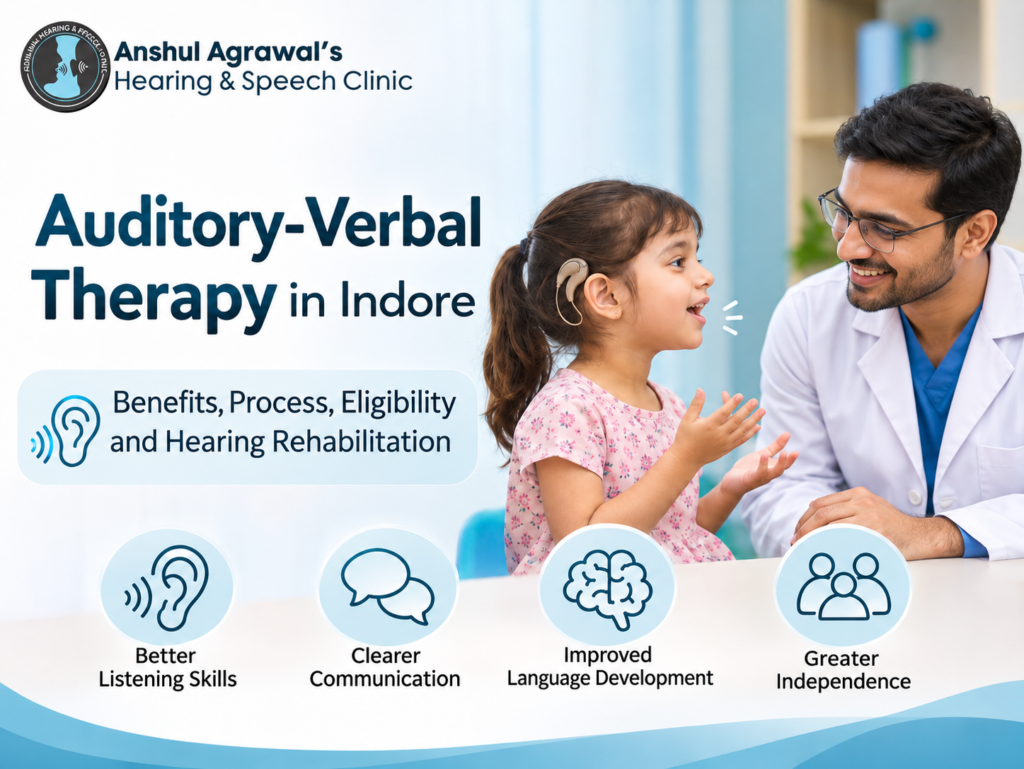
Auditory-Verbal Therapy in Indore is a specialised approach that helps children with hearing loss develop listening and spoken-language skills by making effective use of their available hearing. The therapy focuses on teaching children to listen, understand sounds, develop speech and communicate through spoken language. For children with hearing loss, early intervention can be particularly important because the early years are a significant period for auditory, language and communication development. Auditory-Verbal Therapy, commonly called AVT, uses structured listening activities and active participation from parents or caregivers. At Agrawal Speech & Hearing Clinic, Anshul Agrawal provides hearing and speech-related assessment and therapy for children, adults and senior patients. The clinic focuses on hearing assessment, speech development, auditory rehabilitation, stuttering, speech delay and cochlear implant counselling. What Is Auditory-Verbal Therapy? Auditory-Verbal Therapy is a family-centred intervention designed to help children with hearing loss learn to listen and develop spoken communication. Instead of relying primarily on visual communication, AVT encourages the child to use appropriately supported hearing through hearing aids, cochlear implants or other hearing technology. The therapy may help a child learn to: Detect environmental sounds Recognise speech sounds Differentiate between sounds Understand spoken words Develop listening attention Follow spoken instructions Build vocabulary Develop clearer speech Participate in conversations Improve communication confidence The exact therapy programme depends on the child’s age, hearing level, hearing technology, language development and individual needs. Auditory-Verbal Therapy in South Tukoganj, Indore can therefore involve much more than simply repeating words. It is a structured process that teaches children to make meaningful use of auditory information. Who Can Benefit From Auditory-Verbal Therapy? AVT is particularly associated with children who have hearing loss and are using hearing technology that provides access to sound. Potential candidates may include children with: Congenital hearing loss Early-onset hearing loss Hearing loss identified through newborn screening Children using hearing aids Children with cochlear implants Children who have received cochlear implantation Delayed auditory development Delayed speech and language development associated with hearing loss The suitability of AVT should be determined after a detailed hearing and developmental assessment. Parents looking for AVT for Hearing Loss in Vijay Nagar, Indore should first understand the child’s hearing profile and whether the hearing technology is providing adequate access to speech sounds. AVT is not automatically appropriate for every child with communication difficulties. Children with speech delay caused by other developmental, neurological or language-related factors may require a different or additional therapeutic approach. Why Early Auditory Intervention Matters Hearing plays an important role in how children naturally learn spoken language. A child with significant hearing loss may have limited access to speech sounds. Without appropriate intervention, this can affect vocabulary development, speech production and communication skills. Early identification provides an opportunity to assess hearing and begin appropriate intervention. Early auditory intervention may support: Listening development Speech perception Vocabulary growth Understanding of spoken language Speech production Communication skills Parent-child interaction Auditory-Verbal Therapy for Children in Palasia, Indore can be structured according to the child’s developmental stage rather than simply using the same exercises for every child. How Does Auditory-Verbal Therapy Work? Auditory-Verbal Therapy generally follows a structured listening-based approach. The therapist creates activities that encourage the child to pay attention to sound and understand its meaning. 1. Sound Awareness The child first learns to notice different sounds. These may include: Environmental sounds Voices Musical sounds Household sounds Speech sounds 2. Sound Discrimination The child learns to identify differences between sounds. For example, therapy may gradually help a child distinguish between different speech sounds or words. 3. Word Recognition Once auditory discrimination develops, activities may focus on recognising familiar words. 4. Understanding Spoken Language The child gradually learns to understand words, phrases, instructions and conversations. 5. Spoken Communication The ultimate focus is functional communication, where the child uses spoken language to interact with family members, teachers and peers. Role of Parents in Auditory-Verbal Therapy Parents play an important role in AVT. Therapy sessions alone cannot provide all the listening experiences a child needs. Children learn language through repeated interactions throughout their everyday lives. Parents may be guided to: Speak naturally with the child Use everyday conversations Encourage listening Repeat important words when necessary Create opportunities for the child to respond Use appropriate auditory strategies Monitor hearing-device use Practise activities recommended by the therapist Hearing Rehabilitation Therapy near Geeta Bhawan, Indore may therefore include guidance for parents so that therapeutic listening activities can continue beyond the clinic. This family participation can help integrate listening and spoken-language practice into normal routines such as eating, playing, dressing, reading and travelling. AVT and Hearing Aids Hearing aids can amplify sound for people with hearing loss, but simply wearing a hearing aid does not automatically teach a child how to interpret speech. A child may need time and structured auditory practice to understand the sounds being amplified. AVT can help children learn to make functional use of their available hearing. Therapy may involve: Detecting amplified sounds Listening to speech Identifying words Understanding differences in speech sounds Building auditory memory Developing language through listening AVT for Hearing Loss in Vijay Nagar, Indore should be planned alongside appropriate audiological assessment and hearing-device management. If hearing aids are not functioning correctly or are not appropriately fitted, auditory therapy may become less effective. Regular audiological monitoring is therefore important. Auditory-Verbal Therapy and Cochlear Implants Cochlear implants provide auditory stimulation differently from conventional hearing aids. After implantation and activation, the child generally needs time and structured rehabilitation to learn to interpret the new auditory information. Auditory-Verbal Therapy can be an important component of rehabilitation for some children using cochlear implants. The therapy may focus on: Detecting new sounds Identifying speech Building auditory memory Understanding spoken language Developing vocabulary Improving speech production Using listening skills in everyday situations AV Therapy for Cochlear Implant Children near Bengali Square, Indore may involve close coordination between the family, audiologist, therapist and other professionals involved in the child’s rehabilitation. The rehabilitation process differs from child to child. What Happens During an AVT Session? An AVT session is